 NINETYRISE
Guide
Habit tracker app: what makes one actually work
A good habit tracker makes the right action easy and your progress visible. A bad one turns self-improvement into admin work. Here is how to tell the difference.
Why track habits at all?
Tracking does two things. First, it makes your behaviour visible: it is easy to believe you exercise "most days" until you see the calendar. Second, the act of checking off a habit is a small, immediate reward, and immediate rewards are what keep long-term behaviours going.
Tracking is not the goal, though. The goal is the habit. The best tracker is the one that takes the least effort and gives you the clearest picture.
Features that actually help
- Fast check-off. If logging a habit takes more than a few seconds, you will stop doing it.
- Flexible schedules. Not every habit is daily. Gym three times a week should not show up as four failures.
- A minimum version. A way to log "I did the small version today" protects consistency on hard days.
- Pausing. Illness and travel happen. Pausing a habit is more honest than pretending or breaking it.
- Clear history. Calendars and heatmaps show patterns at a glance: which days you slip, which habits are solid.
- Regular reflection. A short weekly review turns data into decisions.
Features that often get in the way
- Unlimited habits. Tracking 15 things spreads your attention thin. Focus on a few that matter.
- Harsh streak resets. Losing a 40-day streak because of one missed day can make people quit entirely.
- Noise. Ads, social feeds and constant notifications pull you away from the very thing you are trying to build.
How to set up your habits so they stick
- Start with three. Add more only when the first ones feel automatic.
- Make them measurable. "Read 10 pages", not "read more".
- Attach them to a cue. After an existing routine, at a fixed time or in a fixed place.
- Define the minimum. Decide in advance what counts on a bad day.
- Review weekly. Keep what works, shrink what does not.
The NinetyRise habit tracker
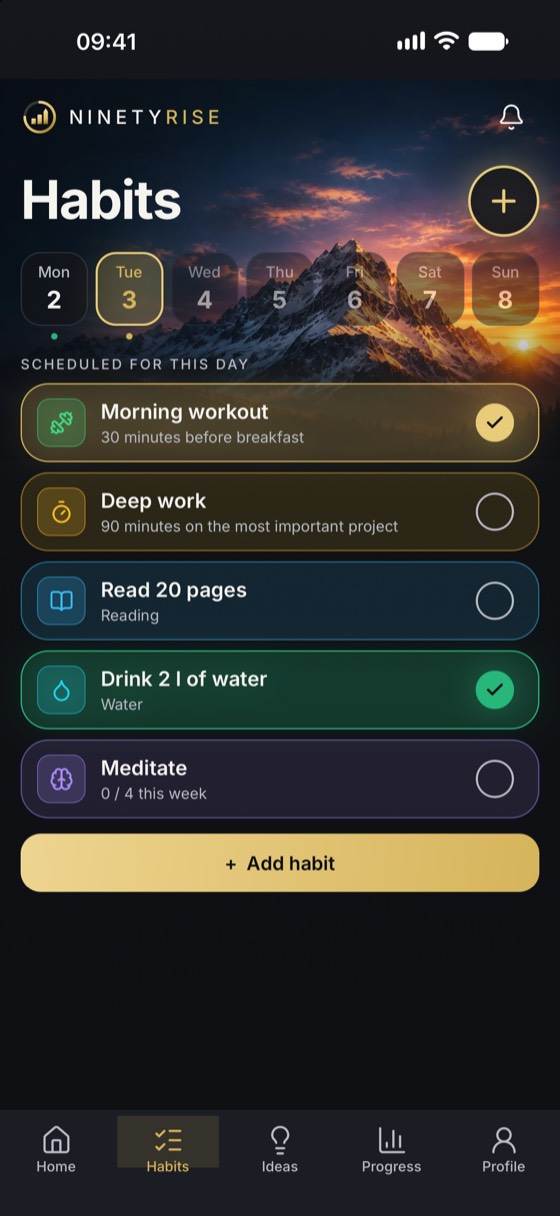
NinetyRise is a habit tracker for iPhone built around one focused 90-day challenge. Habits can be daily or a few times a week, you can pause them when life happens, and each can have a minimum check-off for hard days. You get streaks, monthly calendars and heatmaps, a weekly review with insights and a monthly report.
Around the tracker are the tools that help you do the work: a deep work focus timer, a daily plan with up to three key tasks, voice capture for ideas and optional fitness tracking. There are no ads and no tracking, and your data is stored in the EU.
Frequently asked questions
What is the best habit tracker app?
The best one is the one you keep using. Look for fast check-offs, flexible schedules, a way to handle hard days and a clear history, without ads or distractions.
Should I track habits daily or weekly?
Check off habits daily, when you do them, and review them weekly. The daily check-off keeps you consistent; the weekly review helps you adjust.
Is NinetyRise free?
NinetyRise starts with a 7-day free trial. After that it is an auto-renewing subscription (monthly or yearly) through your Apple ID, which you can cancel anytime.