 NINETYRISE
Guide
The 90-day challenge: how to plan one you will actually finish
A 90-day challenge is a simple promise: for the next three months, you will do a few specific things every day. Here is how to set one up so it survives real life.
What is a 90-day challenge?
A 90-day challenge is a fixed period, roughly one quarter of a year, in which you commit to a small set of daily actions. Instead of a vague resolution like "get fit" or "be more productive", you decide exactly what you will do each day, for example a 30-minute walk, one hour of deep work and reading ten pages.
The challenge has a clear start date, a clear end date and a way to keep score. That combination of a defined goal, a deadline and visible progress is what makes it different from simply "trying to do better".
Why 90 days instead of 21 or 30?
The popular idea that a habit takes 21 days comes from anecdotes, not from research. A study led by Phillippa Lally at University College London followed people building a new daily behaviour and found that reaching automaticity took a median of 66 days, with individual results ranging from 18 to 254 days.
That does not make 90 days a magic number either. It makes it a practical one:
- It outlasts the motivation spike. Most people feel great in week one and struggle in weeks three to six. Ninety days pushes you through that dip and out the other side.
- Results become visible. In three months, consistent effort shows up in your fitness, your work and your mood, which keeps you going.
- It is still finite. A finish line you can see is easier to commit to than "from now on".
- It matches a quarter. Ninety days fits neatly into how many people already plan work and life.
How to choose your habits: the rule of three
The biggest mistake is choosing too much. Ten new habits feel inspiring on day one and impossible on day twelve. Choose three pillars, the habits that would make the biggest difference if you did them every day for three months.
A balanced set often covers three areas:
- Body: a walk, a workout, a fixed bedtime, no sugar after dinner.
- Mind: reading, journaling, meditation, learning a language.
- Work or craft: an hour of deep work, writing, practising an instrument.
Make each habit specific and checkable. "Exercise more" cannot be checked off; "20 minutes of movement" can. Then define a minimum version for bad days, for example five minutes of movement or one page of reading. The minimum keeps the chain alive when life gets busy.
Plan the challenge before day one
- Pick a start date within the next few days, so you do not lose momentum.
- Decide when each habit happens. "After my morning coffee I read ten pages" works better than "sometime today". Researchers call this an implementation intention.
- Set rewards for the end of week one, month one and the finish line. Small, meaningful rewards make progress feel real.
- Decide how you will keep score. A paper calendar works. An app that does the counting for you works better when you are tired.
What to do when you miss a day
You will miss days. Over 90 days that is almost guaranteed, and it is not failure. What matters is what happens next.
- Never miss twice. One missed day is an accident; two in a row is the start of a new pattern. Make the next day a minimum day if you have to.
- Do not restart from zero. All-or-nothing streaks punish one bad day with the loss of weeks of work. Keep going and track your success rate instead.
- Look for the cause. If you keep missing the same habit, it may be too big or scheduled at the wrong time. Shrink it or move it.
How NinetyRise helps you finish
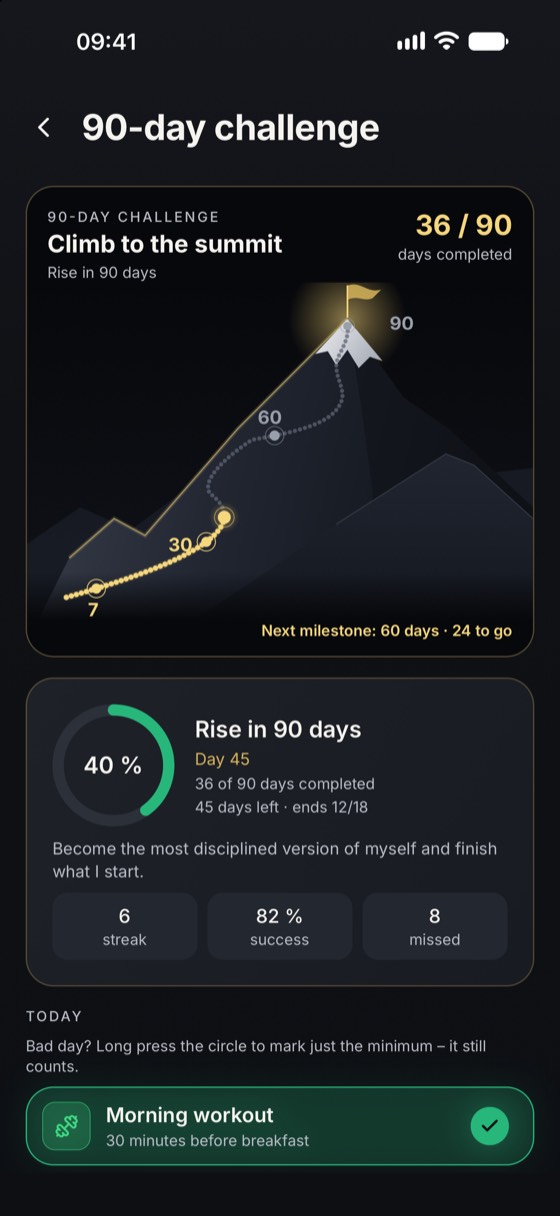
NinetyRise was built around exactly this method. You create a challenge with three pillar habits, fixed dates and your own rewards. Every completed day lights one step on a trail up the mountain, with milestones at 7, 30, 60 and 90 days. On hard days you can log the minimum, and the app shows an honest success rate instead of resetting a streak. Weekly reviews and a monthly report help you adjust as you go, and every milestone becomes a story image you can share.
Frequently asked questions
Is 90 days enough to build a habit?
For many people and many habits, yes, but there is no guarantee. Research shows a wide range: simple habits can become automatic in a few weeks, harder ones take longer. Ninety days is a practical period to build consistency and see results.
How many habits should a 90-day challenge have?
Three is a good number. It is enough to change your days and few enough to keep up when you are busy or tired.
Can I change my habits during the challenge?
It is better to keep your pillars fixed so the challenge stays honest. If a habit is clearly too big, shrink its daily target rather than replacing it.