 NINETYRISE
Guide
How to build discipline without relying on willpower
Disciplined people are not superhuman. They have made the right action easier, the wrong one harder, and they keep small promises to themselves every day.
Discipline is a skill you practise
It is tempting to see discipline as something you either have or you do not. In practice it behaves more like a skill. Every time you do what you said you would do, especially when you do not feel like it, you collect evidence that you are someone who follows through. That self-trust is what makes the next time easier.
This is why small commitments matter so much. Keeping a promise of ten minutes a day builds more discipline than breaking a promise of two hours.
Stop waiting for motivation
Motivation is a feeling, and feelings come and go. If you only act when you feel motivated, your results will be as unpredictable as your mood. Disciplined action usually comes first, and motivation follows once you see progress.
The practical takeaway: decide in advance what you will do and when, so that in the moment there is nothing to negotiate.
Seven practical ways to build discipline
- Start smaller than you think. A habit so small you cannot fail is the foundation for a bigger one.
- Decide when and where. "At 7:00, at my desk, before email" removes daily decisions.
- Design your environment. Put the book on your pillow, the phone in another room, the running shoes by the door.
- Use a minimum on bad days. Doing the small version keeps your identity intact.
- Keep score honestly. A visible record keeps you accountable to yourself.
- Protect focused time. Block time for your most important work and remove distractions while it runs.
- Commit to a finish line. A defined period, like 90 days, turns discipline into a project with a clear end.
Why a 90-day challenge builds discipline
A challenge gives discipline a structure: a few specific daily actions, a start date, an end date and a way to keep score. Each day you either keep your promise or you learn something about why you did not. After three months you have a record of hundreds of kept promises, which is about the most convincing argument there is that you can change.
Read the full guide to planning a 90-day challenge.
How NinetyRise helps
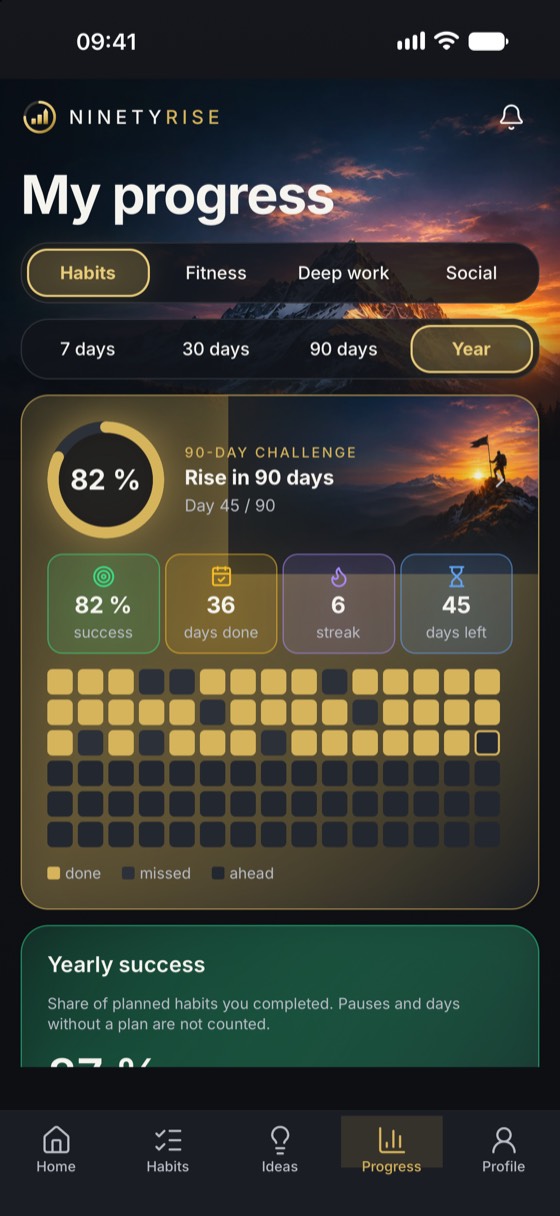
NinetyRise turns this into a daily routine on your iPhone. You choose three pillar habits for a 90-day challenge, check them off in seconds and watch each completed day light up a step on the trail to the summit. Minimum check-offs and pauses keep you going through hard weeks, the deep work timer protects focused time, and the daily plan keeps you on your three most important tasks.
Frequently asked questions
How long does it take to build discipline?
There is no fixed timeline. You start building it the first day you keep a small promise to yourself. A focused period like a 90-day challenge gives you enough repetitions to notice a real difference.
Is discipline more important than motivation?
Both help, but discipline is more reliable. Motivation changes with your mood; a clear plan and small daily commitments work even on days you do not feel like it.
What is the easiest habit to start with?
One that takes less than five minutes and fits an existing routine, such as reading one page after breakfast or a short walk after lunch.